Kody Nexov
 Published
Research-backed decision brief - checked 2026-07-24
iGaming Vendor Migration: the decision-ready answer
A credible implementation answer is a dependency-led plan with owners, entry and exit criteria, evidence gates, data reconciliation, rollback, stabilization, and exit preparation. Supplier timelines remain estimates until scope and prerequisites are fixed.
The assigned US English query igaming vendor lock-in was checked on July 24, 2026. The result pattern was used to validate the page intent and question set.
Evidence standard for this decision
Use Yes only when a current source or test explicitly supports the field; Partial when it supports only part of the scope; Not found when the reviewed public sources do not expose it; and Unknown when it has not yet been evaluated. Not found is not evidence that a capability is absent.
| Decision field | Evidence to request | Pass signal | Keep unresolved when |
|---|---|---|---|
| Prerequisites | Decisions, licences, vendors, credentials, environments, and data | Each dependency has an owner and due date | The plan starts with build activities only |
| Acceptance | Business, technical, compliance, operational, and recovery tests | Go-live is blocked by failed critical evidence | Completion is defined as integration available |
| Cutover | Migration, reconciliation, parallel run, rollback, and communications | Abort thresholds and decision owners are rehearsed | Rollback is a sentence rather than a tested plan |
| Stabilization and exit | Hypercare, defect triage, export, deletion, and transition evidence | Operations and replacement paths are usable | The plan ends at launch |
Questions observed in current demand
The questions below combine the assigned search intent with the evidence gaps found in the current page review.
What prerequisites and dependencies determine the iGaming Vendor Migration timeline?
Answer it for a defined operator profile. Compare only like-for-like options, apply one evidence rule, and leave supplier-specific unknowns open until they are closed by current documentation, testing, references, or contract terms.
Question source: archetype - implementation / migration
Which workstreams, owners, gates, and deliverables belong in each implementation phase?
A credible implementation answer is a dependency-led plan with owners, entry and exit criteria, evidence gates, data reconciliation, rollback, stabilization, and exit preparation. Supplier timelines remain estimates until scope and prerequisites are fixed. Apply that evidence rule specifically to iGaming Vendor Migration and keep unverified product, price, market, and performance claims marked as unknown.
Question source: archetype - implementation / migration
What acceptance scenarios and evidence define a pass before production cutover?
A credible implementation answer is a dependency-led plan with owners, entry and exit criteria, evidence gates, data reconciliation, rollback, stabilization, and exit preparation. Supplier timelines remain estimates until scope and prerequisites are fixed. Apply that evidence rule specifically to iGaming Vendor Migration and keep unverified product, price, market, and performance claims marked as unknown.
Question source: archetype - implementation / migration
Acceptance scenarios
- Rehearse cutover with production-scale data and reconcile source, target, wallet, payment, and reporting totals.
- Fail a critical integration during the rehearsal and execute the documented abort and rollback decision.
- Run a bulk export and deletion-evidence exercise while the supplier relationship is still healthy.
Source boundary and next evidence
The linked study is the direct research source for this page's topic cluster. It publishes the sample or control set, field definitions, classifications, checked date, primary-source ledger, limitations, and downloadable data. It does not replace jurisdiction-specific legal advice, a supplier proposal, authenticated documentation, a production test, customer references, or a signed contract.
Read the procurement research study or download its CSV dataset.
Decision in brief
Plan data, integrations, player continuity, certification, and controlled cutover. The useful comparison is not the longest feature list. It is the combination of operator fit, verifiable evidence, implementation ownership, measurable service levels, and a workable exit path.
What this guide covers
Plan data, integrations, player continuity, certification, and controlled cutover. It is written for program managers, ctos, product, compliance, and operations. The goal is to turn an early market question into requirements that a buying team can verify during discovery, demos, technical review, commercial negotiation, and implementation planning.
This site does not rank providers. It helps a buying team test claims, structure contracts, and plan implementation and exit.
| Area | Evidence to request | Decision owner |
|---|---|---|
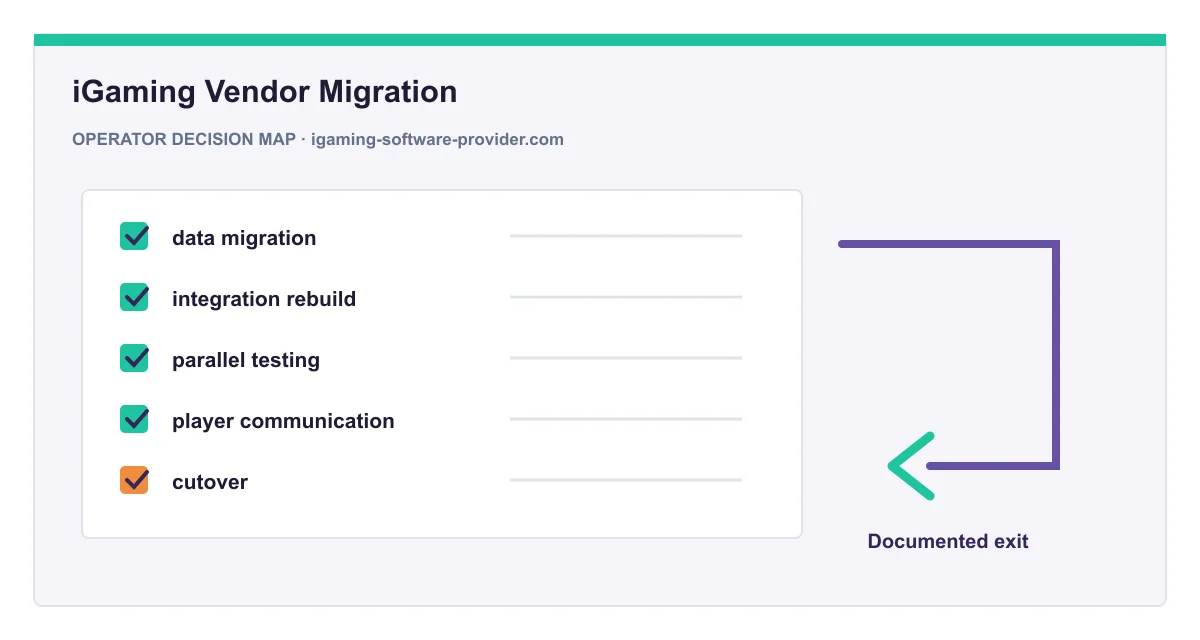
| data migration | Request current documentation or a live workflow showing how data migration is configured, monitored, exported, and supported in production. | Product / operations |
| integration rebuild | Request current documentation or a live workflow showing how integration rebuild is configured, monitored, exported, and supported in production. | Technology / compliance |
| parallel testing | Request current documentation or a live workflow showing how parallel testing is configured, monitored, exported, and supported in production. | Product / operations |
| player communication | Request current documentation or a live workflow showing how player communication is configured, monitored, exported, and supported in production. | Technology / compliance |
| cutover | Request current documentation or a live workflow showing how cutover is configured, monitored, exported, and supported in production. | Product / operations |
Evaluation checkpoints
1. Confirm ownership and operator control of data migration
Define the expected outcome, request proof from the current product, record exceptions, and assign an owner for acceptance.
2. Test integration and data access for integration rebuild
Define the expected outcome, request proof from the current product, record exceptions, and assign an owner for acceptance.
3. Review compliance and audit evidence for parallel testing
Define the expected outcome, request proof from the current product, record exceptions, and assign an owner for acceptance.
4. Put commercial assumptions and exceptions in writing
Define the expected outcome, request proof from the current product, record exceptions, and assign an owner for acceptance.
Implementation sequence
- Define scope and exclusions. Document the operator profile, target market, delivery model, required integrations, and responsibilities that cannot be outsourced.
- Collect comparable evidence. Use the same scenarios and data requests for every candidate. Separate shipped capability from roadmap commitments.
- Run a solution and risk review. Trace critical workflows across product, technology, payments, compliance, operations, finance, and support.
- Convert findings into acceptance criteria. Put dependencies, owners, service levels, data access, timelines, and remedies into the implementation plan and contract.
- Plan controlled go-live and exit. Test degraded modes, reconciliation, incident escalation, rollback, data export, and transition support before production launch.
Questions to put in the RFP
- Show the production workflow and documentation for data migration. Which parts are standard, configurable, third-party, or roadmap-only?
- Show the production workflow and documentation for integration rebuild. Which parts are standard, configurable, third-party, or roadmap-only?
- Show the production workflow and documentation for parallel testing. Which parts are standard, configurable, third-party, or roadmap-only?
- Show the production workflow and documentation for player communication. Which parts are standard, configurable, third-party, or roadmap-only?
- Show the production workflow and documentation for cutover. Which parts are standard, configurable, third-party, or roadmap-only?
- Which operator teams and external suppliers must participate in implementation, testing, and ongoing operation?
- Which data can the operator access in real time, export in bulk, and retain after termination?
- Provide measurable service levels, escalation paths, maintenance rules, and recent incident examples relevant to this scope.
Red flags
- A broad feature claim without versioned documentation or production evidence.
- An integration dependency with no named owner, test plan, or service level.
- Commercial terms that hide third-party fees, minimums, or transition cost.
Frequently asked questions
What should a buyer verify first when evaluating igaming vendor migration?
Start with the operating model and the evidence behind data migration. A feature list is not enough: confirm ownership, configuration limits, implementation dependencies, and the exact production version being offered.
Which teams should review igaming vendor migration?
Program managers, CTOs, product, compliance, and operations should review the decision together. Product fit, technical feasibility, compliance accountability, commercial terms, and day-to-day operations are connected and should not be approved in isolation.
How should vendor claims be compared?
Use the same requirement matrix, evidence standard, and scoring scale for every vendor. Mark unsupported, roadmap-only, or market-specific claims separately instead of treating them as available capability.
What belongs in the contract or implementation plan?
Document scope, acceptance evidence, dependencies, owners, service levels, data access, change control, and exit support. Any requirement tied to cutover should have a named owner and testable acceptance criterion.
Concept map
Related concepts and decision guides
- How to Choose an iGaming Software Provider
- Create a repeatable provider-selection process based on evidence and operator fit.
- iGaming Software Contract Terms guide
- Review scope, acceptance, change control, data, liability, termination, and transition.
- iGaming RFP Template guide
- Structure an RFP that produces comparable answers and exposes exceptions.
- iGaming Software Provider Checklist comparison
- Screen providers before committing to demos and legal review.
- iGaming Software SLA
- Turn availability, support, incident, recovery, and remedy promises into measurable terms.
Evidence layer
Primary references and verification limits
Sources were checked on . They support the standards and verification questions used in this guide. They do not prove a supplier-specific price, market eligibility, implementation result, or private product claim; buyers should request current, versioned evidence for those points.
- iGaming Software Provider - procurement research 2026 Original publisher research. A dated methodology, evidence matrix, primary-source ledger, limitations, and downloadable CSV supporting this page's decision framework.
- UK Gambling Commission — Remote gambling and software technical standards Regulator. Remote gambling software controls, security requirements, player-facing technical controls, and jurisdiction-specific verification questions.
- UK Gambling Commission — Testing strategy for remote gambling software Regulator. Testing, release control, audit evidence, change management, independent review, and production assurance questions.